


AI-Enabled Micro-Crack Inspection at Glass Cartridge Cut Ends
AI-Enabled Micro-Crack Inspection at Glass Cartridge Cut Ends
Demonstrated Risk Reduction, Improved Release Confidence, and Regulatory Alignment
Background
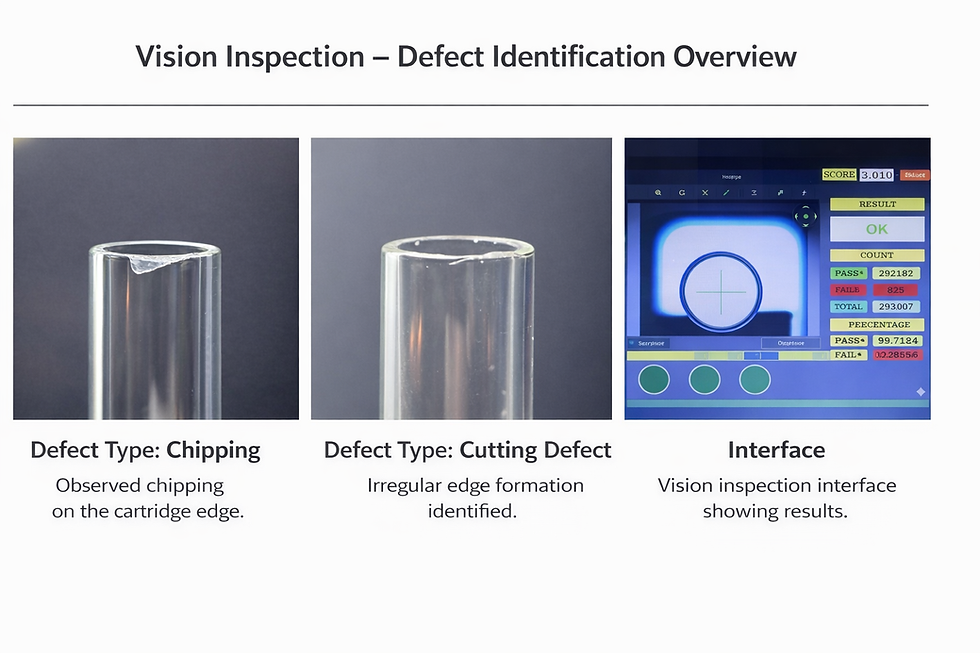
The cut end of a glass cartridge is one of the most mechanically stressed and risk-critical interfaces within the primary container system. Micro-breakages, edge chipping, and hairline cracks generated during the cutting process may not immediately result in visible failure but can propagate during downstream operations, device assembly, or clinical use.To address this latent risk, we have implemented an AI-enabled vision inspection system for 100% inspection of the cartridge cut end. The system is designed to reliably detect micro-cracks and small broken glass edges that are difficult or inconsistent to identify using conventional inspection methods.
How Micro-Cracks Are Generated in the Cutting Process
Glass cartridges are separated on high-speed forming machines using a combination of mechanical scoring and controlled thermal shock. While this process is industry-standard and highly efficient, it inherently introduces localized stress at the cut end, which can lead to microscopic defects.
The cutting sequence typically includes:
• Mechanical Scoring: A small cutting wheel makes a light 360-degree score around the cartridge, defining the separation line but creating a stress concentration.
• First Thermal Shock (Burner Heating): A high-temperature burner heats the scored area to initiate controlled fracture along the score line.
• Water Quench: A targeted water spray rapidly cools the heated area to complete separation; uneven cooling can cause micro-fractures.
• Second Thermal Shock (Edge Conditioning): A second burner conditions and stabilizes the cut edge but may amplify pre-existing defects, alternately it can also hide microcracks in glazing itself which could lead for future failures.
Because this process relies on repeated cycles of rapid heating and cooling, the cut end is inherently prone to microscopic damage that is often invisible to the naked eye.
Key Process Variables Affecting Cut Quality
• Scoring Wheel Wear: Gradual loss of sharpness increases risk of irregular fractures and micro-chipping.
• Pneumatic Pressure Variations: Fluctuations in air pressure or alignment can lead to under- or over-scoring.
• Gas Quality Variability: Variations in calorific value affect flame stability and heating consistency.
These unavoidable sources of variability justify the need for 100% AI-based micro-crack inspection rather than reliance on periodic tool changes or manual visual checks.
Limitations of Rule-Based Vision Inspection
• Dependence on fixed parameters that cannot adapt to process variability.
• Sensitivity to normal variation, causing false rejects or missed defects.
• 'One-size-fits-all' constraints across machines and lots.
AI-enabled inspection uses machine learning trained on thousands of images to distinguish true defects from harmless optical artifacts, providing more reliable classification.
Regulatory and Quality Rationale
• USP <660>/<660.1> – Glass container quality
• USP <788>/<790> – Particulate control
• USP <1207> – Container Closure Integrity
• ISO 11040 – Cartridge performance
• EU GMP Annex 1 – Contamination control
• ICH Q9 – Quality Risk Management
• 21 CFR 211.94 – Container suitability
Inspection coverage: 100% of cartridges at the cut-end position
Observed reject rate: ~0.3%
Defects detected: Micro-breakages, edge chipping, hairline cracks
Post-implementation outcomes:
• No cut-end defects observed during manual inspection and pre-release Audit
• Stable performance across multiple batches
• Improved batch release confidence
Quality and Regulatory Impact
AI-based inspection provides objective, repeatable, and data-driven detection of micro-cracks, reducing operator dependency and variability.
• Improved Container Closure Integrity (CCI)
• Reduced particulate risk
• Lower risk of downstream failures in filling and device assembly
Risk if Micro-Defects Remain Undetected
• Latent crack propagation
• Glass particle release
• Plunger damage and leakage
• Device-level failures
• Market complaints with complex investigations
Economic Value Proposition: Risk vs. Cost
• While competitors may offer lower unit prices, they pass the hidden costs of risk to the pharmaceutical manufacturer:
• The Cost of a Field Recall: Millions in lost product and brand damage.
• Secondary Failures: A single micro-crack can cause a cartridge to shatter in a high-speed filling line, leading to hours of downtime for decontamination and or broken machine parts that can cause even longer delays due to unavailability of replacement parts.
• Complaint Investigations: AI provides a data trail for every batch, simplifying CAPA processes.
Conclusion
At Kapoor Glass, we believe that "good enough" is a liability in primary packaging.
The implementation of AI-enabled micro-crack inspection at the cartridge cut end has resulted in quantifiable defect detection (~0.3%), elimination of manual inspection findings, and improved batch release confidence. This represents a clear shift to data-driven, AI-based quality control aligned with modern regulatory expectations.
Comments